MagSafe Charging: Complete Guide to Pros, Cons, FAQs & Everything You Need to Know (2025)
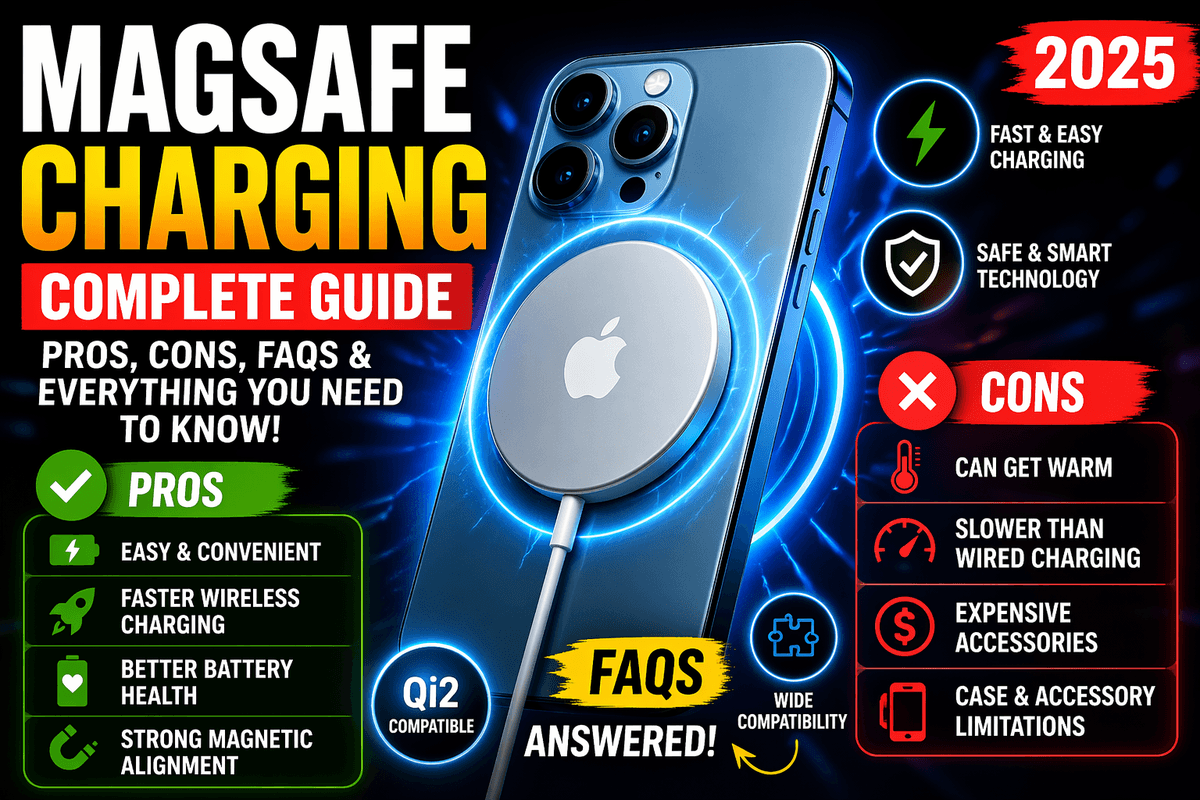
Table of Contents
- Introduction: The MagSafe Revolution That Changed How We Charge
- What Is MagSafe Charging? A Clear Explanation
- How Does MagSafe Charging Work Technically?
- MagSafe Charging: The Full List of PROS
- 1. Effortless, One-Handed Attachment
- 2. Faster Wireless Charging Speed (Up to 15W)
- 3. A Rich, Expanding Ecosystem of Accessories
- 4. No Port Wear and Tear
- 5. Safe Disconnection — No Cable Yanking Damage
- 6. Certified Accessory Authentication and Safety
- 7. Charging While Using the Phone Comfortably
- 8. Cleaner, Cable-Free Desk Aesthetics
- 9. Great for Overnight and Travel Charging
- 10. Qi2 Standardization — Broader Compatibility Coming
- MagSafe Charging: The Full List of CONS
- 1. Premium Price Tag — Significantly More Expensive
- 2. Still Slower Than Wired Charging
- 3. Heat Generation — A Real Concern for Battery Health
- 4. Requires a Compatible Power Adapter — Not Included
- 5. Slightly Reduced Efficiency vs. Wired Charging
- 6. Case Compatibility Complications
- 7. Limited Charging Surface Flexibility
- 8. Not Compatible with All iPhone Models
- 9. Wallet Concerns — Credit Card Demagnetization
- 10. The 15W Rate Requires Specific Conditions
- MagSafe vs. Standard Qi Wireless Charging: A Side-by-Side Comparison
- MagSafe vs. Wired USB-C Charging: Which Is Better?
- Is MagSafe Safe for Your iPhone Battery?
- MagSafe Charging Tips to Get the Most Out of It
- Top MagSafe Chargers Worth Considering in 2025
- The Future of MagSafe: Where Is It Heading?
Introduction: The MagSafe Revolution That Changed How We Charge

Apple has never been shy about reinventing the wheel. From ditching the headphone jack to replacing the Home button with Face ID, the Cupertino giant has a long track record of controversial-but-consequential decisions. MagSafe charging is no different.
Originally introduced on MacBook laptops in 2006 as a magnetic power connector, MagSafe made a dramatic comeback in October 2020 with the iPhone 12 lineup — this time reimagined as a magnetic wireless charging ecosystem for smartphones. Since then, it has become one of the most talked-about, polarizing, and genuinely useful features in the modern iPhone lineup.
But is MagSafe charging actually worth it in 2025? Is it fast enough, safe enough, and practical enough to justify its premium price tag over standard Qi wireless charging or traditional wired charging? This comprehensive guide dives deep into every angle — the real-world advantages, the honest drawbacks, how MagSafe compares to alternatives, safety concerns, and answers to the most frequently asked questions — so you can make a fully informed decision.
What Is MagSafe Charging? A Clear Explanation
MagSafe for iPhone is a proprietary Apple charging system that uses an array of magnets embedded in the back of compatible iPhones (iPhone 12 and later) to snap accessories — including chargers, wallets, cases, and battery packs — into perfect alignment.
At its core, MagSafe is built on the Qi wireless charging standard, but Apple has enhanced it with three key additions:
Magnetic Alignment Ring: A circular ring of magnets ensures the charger attaches and stays perfectly centered on the charging coil, maximizing energy transfer efficiency.
NFC Communication: A small NFC chip embedded near the magnet array allows the iPhone to communicate with attached MagSafe accessories, enabling authentication, accessory identification, and feature unlocking.
Enhanced Charging Protocol: When the iPhone detects an authentic Apple MagSafe charger, it unlocks a higher power delivery mode — up to 15W — compared to the standard 7.5W offered to regular Qi chargers.
MagSafe is supported on the iPhone 12, 13, 14, 15, and 16 series. The Apple Watch has used a different variant of MagSafe (magnetic inductive charging) since the original Apple Watch in 2015. The MacBook Pro and MacBook Air also use a third variant — a magnetic snap-in cable connector.
For this article, we focus specifically on iPhone MagSafe wireless charging — the ecosystem that has grown into a rich platform of accessories and attachments.
How Does MagSafe Charging Work Technically?
Understanding the technology helps you use it smarter. Here's the technical breakdown:
MagSafe operates on the same electromagnetic induction principle as all Qi chargers. An alternating current passes through a coil in the charger, generating an oscillating magnetic field. This field induces a current in the receiving coil inside your iPhone, which is then used to charge the battery.
What makes MagSafe different is precision alignment. Qi chargers work within a zone, but misalignment causes energy waste and heat generation. MagSafe's magnetic ring solves this by physically snapping the charger into the exact center of the iPhone's receiving coil — every single time, automatically.
The NFC chip plays a crucial authentication role. When the phone detects a genuine Apple MagSafe charger via NFC handshake, the iPhone's power management controller allows the charger to ramp up to the full 15W charging rate. Third-party Qi2-certified chargers can also achieve 15W on compatible iPhones, since Qi2 — the open wireless charging standard launched in 2023 — is essentially based on MagSafe's magnetic alignment technology.
The entire system requires a 20W or higher USB-C power adapter to deliver the full 15W to your iPhone — the charger cable itself draws additional overhead power, so a 20W brick is the minimum recommended.
MagSafe Charging: The Full List of PROS
1. Effortless, One-Handed Attachment
The single most satisfying thing about MagSafe is also its most practical: you can snap your iPhone onto the charger with one hand, in the dark, without looking. The magnetic snap is firm, tactile, and unmistakable. There's no fumbling to center the phone on a charging pad, no waking up to find your phone sitting at 12% because it slid off the sweet spot overnight. For people who charge their phones on a bedside table in the dark, this alone is a game-changer.
2. Faster Wireless Charging Speed (Up to 15W)
Standard Qi wireless charging for iPhones is capped at 7.5W by Apple — a speed that feels glacial in 2025. MagSafe doubles that ceiling to 15W, which is a meaningful real-world difference. In informal tests, MagSafe can take an iPhone from 0% to approximately 50% in around 60–65 minutes, compared to roughly 90 minutes or more with standard Qi wireless charging. While wired charging (USB-C with a fast charger) is still faster, MagSafe closes the gap considerably, making cord-free charging a genuinely viable daily option rather than just a bedside novelty.
3. A Rich, Expanding Ecosystem of Accessories
MagSafe's real superpower is not just charging — it's the ecosystem it anchors. Apple and hundreds of third-party manufacturers have built an enormous catalog of MagSafe-compatible accessories:
Wallet attachments: Thin card holders that snap to the back of your phone for a minimalist carry.
Cases: Thousands of cases with embedded magnet rings maintain MagSafe compatibility while protecting your phone.
Car mounts: MagSafe car mounts hold your phone securely on your dashboard or vent without any clamp or sticky pad — the magnets are strong enough to handle bumpy roads.
Desk stands and ring holders: Elegant desktop charging stands that double as viewing stands.
Battery packs: Apple's own MagSafe Battery Pack and many third-party alternatives snap to the back of your iPhone for on-the-go charging without cables.
Multi-device charging pads: MagSafe-compatible pads that charge your iPhone, Apple Watch, and AirPods simultaneously.
This modular, magnetic ecosystem makes MagSafe far more than a charger — it's a platform.
4. No Port Wear and Tear
Every time you plug in a cable, you introduce physical stress to your device's charging port. Over thousands of insertions and removals — or years of daily use — ports can loosen, corrode, or fail. MagSafe eliminates this entirely. With no cable plugged into the phone itself, the Lightning or USB-C port is preserved for other uses (or avoided altogether). This is particularly relevant for users who charge their phones multiple times a day.
5. Safe Disconnection — No Cable Yanking Damage
If someone trips over your phone charger, with a traditional cable, the cable yanks the phone and can send it flying off a table. With MagSafe, a sharp tug simply separates the magnetic connection cleanly — just like the original MagSafe on MacBooks saved countless laptops from being pulled off desks. This is a small but genuine safety and durability advantage.
6. Certified Accessory Authentication and Safety
The NFC-based authentication system in MagSafe ensures that when you're using an Apple-certified MagSafe charger, your iPhone recognizes and trusts it. Apple's Made for iPhone (MFi) certification program, applied to MagSafe accessories, provides a layer of quality assurance. The iPhone's power management system negotiates the charging profile with the charger, reducing the risk of overvoltage or incompatible power delivery. This is in contrast to cheap, uncertified third-party Qi chargers, which can occasionally deliver inconsistent power.
7. Charging While Using the Phone Comfortably
With a MagSafe charger and a good stand or holder, you can charge your iPhone while holding it, using it for video calls, watching content, or mapping navigation — all without a cable dangling from the bottom. The magnetic attachment is strong enough to hold the charger to the phone even when the phone is angled or tilted (though not when held vertically in the air). This ergonomic flexibility is a meaningful quality-of-life improvement.
8. Cleaner, Cable-Free Desk Aesthetics
For the minimalism-minded, MagSafe enables a genuinely cleaner desktop setup. A single MagSafe puck or a multi-device charging stand can replace a tangle of cables, creating a tidier, more intentional workspace. Many productivity-focused users cite the aesthetic improvement as a surprisingly important daily benefit.
9. Great for Overnight and Travel Charging
MagSafe's combination of reliable alignment, automated snap attachment, and decent speed makes it ideal for overnight charging. You set it on the stand or puck, and the phone charges. No missed connections. For travel, the flat, lightweight MagSafe puck is a convenient companion — lighter than carrying a cable for many users, and compatible with any USB-C power source.
10. Qi2 Standardization — Broader Compatibility Coming
Apple's MagSafe technology formed the foundation of the Qi2 open standard, developed by the Wireless Power Consortium and launched in 2023. This means the MagSafe ecosystem is no longer exclusively Apple-controlled — Qi2-certified chargers from any manufacturer can now deliver 15W magnetic wireless charging to compatible iPhones (and eventually Android devices with Qi2 support). This broader standardization future-proofs MagSafe technology and ensures growing cross-device compatibility.
MagSafe Charging: The Full List of CONS

1. Premium Price Tag — Significantly More Expensive
The most immediate and obvious downside of MagSafe is cost. Apple's official MagSafe Charger retails for around $39 USD. A quality third-party Qi wireless charger can be purchased for $10–$15, and a USB-C cable can be found for as little as $5–$8. When you scale this to multiple chargers for home, office, and travel — plus MagSafe-compatible cases, mounts, and accessories — the total ecosystem cost adds up quickly. For budget-conscious consumers, this premium is hard to justify when alternatives exist.
2. Still Slower Than Wired Charging
At 15W, MagSafe is fast for wireless charging — but it's not the fastest charging method for iPhones. Apple supports up to 27W+ fast charging via USB-C with a compatible adapter and cable, which is nearly double the MagSafe maximum. In a head-to-head test charging an iPhone from 0–100%, wired USB-C fast charging can complete the task in approximately 60–75 minutes, while MagSafe takes 90–110 minutes depending on the iPhone model and ambient temperature. For users who regularly need to get maximum charge in minimum time, wired remains the fastest option.
3. Heat Generation — A Real Concern for Battery Health
MagSafe charging generates more heat than wired charging, and heat is one of the primary enemies of lithium-ion battery longevity. During MagSafe charging sessions — especially in warmer environments or when using the phone simultaneously — iPhones can get noticeably warm. Apple acknowledges this and has built in thermal management: if the iPhone gets too hot, it throttles the charging rate (sometimes down to 7.5W or even lower) to protect the battery. Repeated and prolonged heat exposure during charging can, over months and years, contribute to faster battery capacity degradation. This is not a dealbreaker, but it's a legitimate long-term consideration.
4. Requires a Compatible Power Adapter — Not Included
Apple no longer includes power adapters in the iPhone box, and this applies to MagSafe too. The MagSafe charger cable itself requires a USB-C power adapter, and to achieve the full 15W rate, you need a minimum of a 20W USB-C adapter. Apple sells its 20W USB-C Power Adapter for around $19 separately. So the full MagSafe setup can cost $39 (charger) + $19 (adapter) = $58 before you've bought a single other accessory. That's a substantial barrier compared to plugging in a $6 USB-C cable.
5. Slightly Reduced Efficiency vs. Wired Charging
All wireless charging, including MagSafe, is inherently less energy-efficient than wired charging. Electromagnetic induction involves energy losses through heat and electromagnetic radiation. Estimates vary, but wireless charging typically draws 20–30% more energy from the wall outlet to deliver the same charge as a cable. Over the course of a year of daily charging, this energy inefficiency is both a financial cost (slightly higher electricity bills) and an environmental consideration. For eco-conscious users, this is worth acknowledging.
6. Case Compatibility Complications
While there are thousands of MagSafe-compatible cases available, not every case on the market works well — or at all — with MagSafe. Thick cases, metal cases, or cases without embedded magnet rings can interfere with the magnetic connection, reducing attachment strength or blocking the NFC communication needed to unlock 15W charging. If you use a heavy-duty protective case from a brand that hasn't built in MagSafe support, you may find the MagSafe charger won't snap properly or charges at a reduced rate. Checking case compatibility before purchase is an extra step that wired charging never requires.
7. Limited Charging Surface Flexibility
With a standard Qi wireless charging pad, you can place the phone in various orientations — landscape, portrait, face up, face down (on some pads). MagSafe, by contrast, snaps to a fixed magnetic point on the back of the phone. While this is usually fine, it means the charging puck always attaches to the same spot — the center-back of the device — and cannot accommodate non-standard orientations or multiple devices simultaneously on a single puck. Multi-device MagSafe charging requires multi-device MagSafe-specific stands or pads.
8. Not Compatible with All iPhone Models
MagSafe wireless charging (the magnetic variety for phones) is only supported on iPhone 12 and later. Users with iPhone 11, XR, XS, X, or earlier models cannot use MagSafe accessories. While this narrows the relevant audience, it's worth noting for users who upgrade less frequently or who are buying for family members with older devices.
9. Wallet Concerns — Credit Card Demagnetization
The strong magnets in MagSafe accessories, particularly MagSafe wallets and cases, can pose a risk to items sensitive to magnetic fields. Traditional magnetic-stripe credit cards, hotel key cards, transit cards, and some ID badges can be damaged or demagnetized by prolonged exposure to strong magnets. While most modern EMV chip credit cards are less susceptible, magnetic stripe data can still be affected. Apple acknowledges this risk and advises not to store magnetic-stripe cards directly next to MagSafe accessories.
10. The 15W Rate Requires Specific Conditions
The headline 15W charging speed of MagSafe is real — but it doesn't always happen. Several factors can reduce the rate below 15W: using a non-Apple or non-Qi2 certified charger (capped at 7.5W), using a sub-20W adapter, high ambient temperature, running demanding apps simultaneously, having a thick or incompatible case, or the iPhone's battery management system throttling for thermal protection. In real-world daily use, many users charge at 12W or 13W rather than the peak 15W — still good, but worth setting realistic expectations.
MagSafe vs. Standard Qi Wireless Charging: A Side-by-Side Comparison
Feature | MagSafe | Standard Qi |
|---|---|---|
Max Charging Speed (iPhone) | 15W | 7.5W |
Magnetic Alignment | Yes | No |
Ecosystem of Accessories | Extensive | Limited |
Price (Charger) | ~$39 | $10–$20 |
Heat Generation | Moderate–High | Moderate |
Case Compatibility | MagSafe-required cases | Most cases work |
Open Standard | Qi2 (2023+) | Yes (Qi) |
NFC Authentication | Yes | No |
Cross-Device Support | iPhone 12+ | Most smartphones |
MagSafe vs. Wired USB-C Charging: Which Is Better?
Feature | MagSafe | Wired USB-C |
|---|---|---|
Max Speed | 15W | 27W+ |
Convenience | High (cable-free) | Moderate (cable required) |
Port Wear | None | Yes |
Energy Efficiency | Lower | Higher |
Cost | Higher | Lower |
Speed from 0–50% | ~60–65 min | ~35–40 min |
Speed from 0–100% | ~100–110 min | ~60–75 min |
Heat Generation | Moderate–High | Low–Moderate |
Verdict: Wired USB-C is strictly faster and more energy-efficient. MagSafe wins on convenience and cable-free freedom. The ideal setup for most users is both: MagSafe for everyday casual charging and overnight, wired for when you need a fast top-up.
Is MagSafe Safe for Your iPhone Battery?
This is one of the most common concerns, and it deserves a nuanced, honest answer.
Short-term safety: Yes, MagSafe is safe for your iPhone battery in the short term. Apple's engineering team has implemented multiple safeguards: thermal monitoring, automatic charge rate throttling, and Apple's Optimized Battery Charging feature (which learns your charging routine and delays reaching 100% until just before you need the phone). These systems protect the battery during normal use.
Long-term considerations: Heat is the primary concern. Lithium-ion batteries degrade faster when regularly exposed to elevated temperatures. Because MagSafe runs warmer than wired charging, and because heat accelerates chemical degradation in battery cells, heavy MagSafe users may see slightly faster capacity decline over 2–3 years compared to wired charging users. This is difficult to quantify precisely because so many variables affect battery health, but it is a real physical principle, not marketing speculation.
Practical advice: Use Optimized Battery Charging (Settings > Battery > Battery Health & Charging). Avoid charging in hot environments. Don't use processor-intensive apps while charging via MagSafe for extended periods. Don't leave your phone on a MagSafe charger in a car on a hot day.
MagSafe Charging Tips to Get the Most Out of It
Use a 20W or higher USB-C adapter — A 12W or 18W adapter will bottleneck your charging speed below 15W.
Use Apple-certified or Qi2-certified chargers — Off-brand chargers without proper certification may cap at 7.5W or behave inconsistently.
Enable Optimized Battery Charging — This feature reduces long-term battery stress by not holding the battery at 100% for hours.
Don't leave it on all day in a hot environment — Thermal damage accumulates over time.
Choose a MagSafe-certified case — Look for the "Works with MagSafe" badge to ensure full compatibility and 15W charging.
Consider a multi-device MagSafe stand — Charging iPhone, Apple Watch, and AirPods from a single elegant stand is one of the best MagSafe setups available.
Use MagSafe in StandBy mode — iOS 17 introduced StandBy, a full-screen smart display mode that activates when iPhone is on MagSafe in landscape orientation — one of the most visually satisfying MagSafe use cases.
Keep your phone and charger clean — Dust, lint, and oils can reduce magnetic contact strength and charging efficiency. Wipe both surfaces regularly.
Top MagSafe Chargers Worth Considering in 2025
While Apple's own MagSafe Charger is the gold standard for compatibility, the market has expanded significantly:
Apple MagSafe Charger (USB-C, 1m/2m) — The reference product. Guaranteed compatibility, sleek design, 15W.
Anker MagSafe-Compatible Charger (Qi2 Certified) — Qi2 certification ensures 15W and strong magnet alignment at a slightly lower price than Apple.
Belkin BoostCharge Pro 3-in-1 MagSafe Charging Stand — Excellent multi-device stand for iPhone + Apple Watch + AirPods.
ESR HaloLock Kickstand Charger — A budget-friendly option with a built-in kickstand for versatile desktop use.
Moment MagSafe Charging Stand — Premium build quality, great for professional desk setups.
Always verify Qi2 or "Works with MagSafe" certification before purchasing from non-Apple brands.
The Future of MagSafe: Where Is It Heading?
MagSafe's future looks bright for several compelling reasons. First, the Qi2 standardization means the ecosystem is no longer dependent solely on Apple's hardware decisions — Android manufacturers are beginning to integrate Qi2 support, which could dramatically expand MagSafe accessory compatibility. Second, Apple has consistently evolved MagSafe with each iPhone generation. Third, with the iPhone moving fully to USB-C, Apple now has a unified charging language that allows MagSafe to coexist cleanly with fast wired charging rather than competing with Lightning's limitations.
Rumors and analyst predictions for future MagSafe development include higher wattage charging (potentially 25W+), expanded Apple Watch and AirPods MagSafe integration, and MagSafe-enabled MacBook accessories.
Try Our Phone Diagnostic Flow
Walk through a step-by-step flow to diagnose charging issues.
Phone Diagnostic Flow
Answer questions to diagnose your charging issue
What's happening with your phone?
Frequently Asked Questions

Written by
BatteryGuides Editorial Team
Our team of battery experts researches and tests every guide to ensure accuracy. We're committed to helping you get the most out of your phone, laptop, and solar batteries.