Power Bank vs Wall Charger — Which One Is Actually Better?
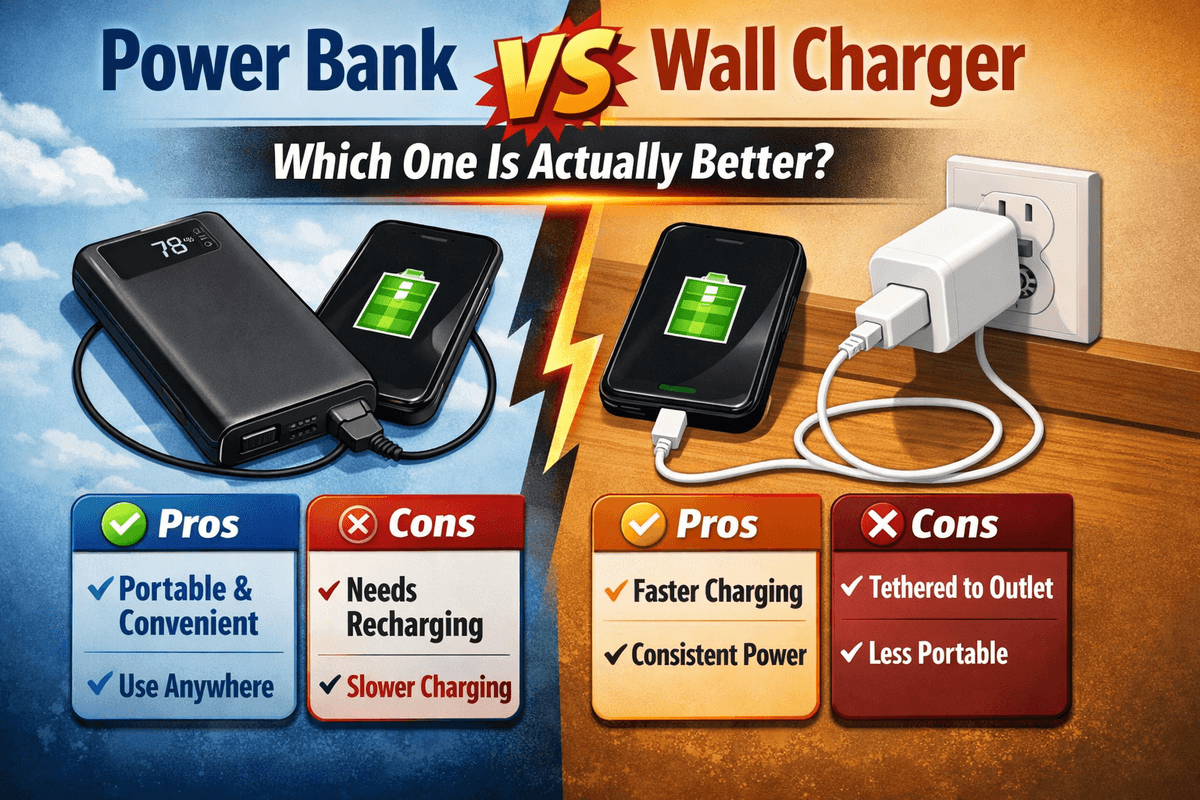
Table of Contents
- Understanding the Basics First
- Charging Speed: Wall Charger Wins Hands Down
- Portability: Power Bank Is the Undisputed Champion
- Reliability and Consistency
- Cost: What Are You Really Paying For?
- Safety: Which One Is Safer to Use?
- Power Bank vs Wall Charger for Travel
- Which Is Better for Your Smartphone Battery Health?
- The Verdict: Power Bank vs Wall Charger — Which One Should You Choose?
- Final Thoughts
If you have ever found yourself staring at a dying phone screen in the middle of nowhere, desperately hoping to find an outlet somewhere, you already know how important charging is in our daily lives. The debate around power bank vs wall charger has been going on for years, and honestly, people still get confused about which one to rely on. Both are useful, both have their place, but they are not the same thing and they definitely do not serve the same purpose equally.
In this guide, we are going to break everything down for you in a way that actually makes sense. No technical jargon, no confusing charts — just real, honest talk about which charging method works best, when, and for whom. Whether you are a frequent traveler, a student, a professional, or just someone who wants to stop worrying about battery life, this article is going to help you figure out exactly what you need.
Understanding the Basics First
Before we dive into the power bank vs wall charger comparison, it is worth taking a moment to understand what each device actually does.
A wall charger is exactly what the name suggests. It is a small adapter that plugs directly into your electrical outlet at home, in the office, or basically anywhere that has access to alternating current (AC) power. The wall charger converts that AC power into direct current (DC) which your phone, tablet, or laptop can safely use. Wall chargers have been around since the very beginning of mobile phones and they remain one of the most reliable and efficient ways to charge your devices.
A power bank, on the other hand, is essentially a portable battery. It stores electrical energy inside it and lets you charge your devices without needing to be near a wall outlet. Power banks come in all shapes, sizes, and capacities. Some are slim and barely noticeable in your pocket while others are bulky enough to charge a laptop multiple times. The technology inside a power bank involves lithium-ion or lithium-polymer cells, and the capacity is measured in milliampere-hours (mAh).
Now that we know what each device is, let us get into what really matters.
Charging Speed: Wall Charger Wins Hands Down
When it comes to raw charging speed, the wall charger is the clear winner. A modern wall charger, especially one that supports fast charging technologies like Qualcomm Quick Charge, USB Power Delivery, or GaN (Gallium Nitride) charging, can push anywhere from 20 watts to 140 watts of power directly into your device. This means your phone can go from zero to sixty percent in under half an hour.
A power bank, even the best portable charger on the market, has to manage its own internal battery while simultaneously sending power to your device. This creates what is called a conversion loss, meaning some of the stored energy is lost in the process. Even high-end power banks with fast charging support usually top out at 65 watts for phones and slightly higher for laptops, but most affordable power banks deliver somewhere between 10 to 18 watts which is noticeably slower than a wall charger.
If charging speed is your top priority and you are sitting at home or in a hotel room, always pick the wall charger. Your device will thank you with a full battery in significantly less time.
Portability: Power Bank Is the Undisputed Champion
Here is where the power bank absolutely dominates the conversation. A wall charger is useless without a power outlet. Simple as that. If you are on a long flight, hiking in the mountains, stuck in traffic, or attending an all-day conference where outlets are nowhere to be found, a wall charger is essentially just dead weight in your bag.
A power bank, however, is freedom in your pocket. The best portable chargers available today are compact, lightweight, and capable of holding enough charge to fill your smartphone two, three, or even five times depending on the capacity. A 10,000 mAh power bank can charge an average smartphone around two to three times, while a 20,000 mAh power bank is almost like carrying a small power station.
For frequent travelers, digital nomads, outdoor enthusiasts, and students who are constantly on the move, the power bank vs wall charger debate is essentially settled in favor of the power bank simply because of portability. If you cannot plug in, you cannot charge — and that is a situation the power bank was designed to solve.
Reliability and Consistency
Wall chargers are incredibly reliable. As long as there is power flowing through your outlet, your charger is going to deliver a steady, consistent current to your device. There is no risk of it running out of stored energy mid-charge. The power company handles all of that. For someone who has a predictable routine at home or in the office, a wall charger is one of the most dependable tools in their tech setup.
Power banks, on the other hand, require you to remember to charge them. This sounds simple but it is a genuine pain point for many users. You could be rushing out the door in the morning, grab your power bank, and realize it is sitting at 10 percent because you forgot to plug it in overnight. Also, over time, the battery capacity of a power bank degrades just like any other rechargeable battery. After 300 to 500 charge cycles, you might notice that your power bank does not hold as much charge as it used to.
That said, modern power banks have gotten significantly better at managing their internal batteries. Many come with smart charging chips and trickle charge technology that help maintain battery health over time. If you buy a quality power bank from a reputable brand and take care of it properly, it should serve you reliably for two to four years.
Cost: What Are You Really Paying For?
Wall chargers are generally more affordable than power banks, especially the basic versions. A standard wall charger for a smartphone can cost anywhere from five to twenty dollars. Even premium fast charging wall adapters with GaN technology rarely cross the fifty dollar mark unless you are looking at multi-port, high-wattage options.
Power banks, however, have a wider price range tied directly to their capacity and features. A basic 5,000 mAh power bank can cost around ten to fifteen dollars, while a high-capacity 20,000 mAh model with fast charging and multiple ports might set you back anywhere from forty to one hundred dollars. Solar-powered power banks or those designed for outdoor and rugged use can cost even more.
From a pure value standpoint, a wall charger gives you unlimited charging as long as you have access to electricity, which makes it the most cost-effective option in the long run. A power bank is a one-time investment that offers you charged devices in situations where no outlet is available, which has its own kind of value that is harder to measure in dollars.
Safety: Which One Is Safer to Use?
Both wall chargers and power banks are generally safe to use when you purchase them from trusted brands and use them as directed. However, there are important safety distinctions worth knowing.
Wall chargers can be dangerous if you use cheap, unbranded knockoffs. Poor quality wall adapters sometimes fail to regulate voltage properly, which can lead to overheating, damage to your device battery, or in rare cases, fire hazards. Always look for chargers that are certified by recognized safety standards like UL, CE, or FCC.
Power banks carry a slightly different set of risks. Since they contain lithium-ion or lithium-polymer batteries, there is always a small risk of swelling, leaking, or thermal runaway if the battery is damaged, overcharged, or exposed to extreme temperatures. Airlines have specific regulations about the capacity of power banks you can carry in your luggage for this reason. Most power banks up to 100 watt-hours (roughly 27,000 mAh at 3.7 volts) are allowed in carry-on baggage but not in checked luggage.
Overall, both options are safe when used correctly. Buy from reputable brands, avoid extreme temperatures, and do not use damaged cables or adapters.
Power Bank vs Wall Charger for Travel
If you are a traveler, this section is probably the most relevant to you. Travel introduces a unique set of challenges around charging. Different countries have different plug types and voltage standards. Carrying a universal travel adapter alongside your wall charger can solve the plug compatibility issue, but it adds another item to your already packed bag.
A power bank eliminates this issue entirely. Once it is charged, it goes wherever you go without needing a compatible outlet in a foreign country. For international travelers, a high-capacity power bank is often considered an essential travel accessory.
That said, if you are staying at a hotel or Airbnb for multiple nights, you will still want to charge your power bank overnight using a wall charger. So in travel situations, the ideal setup is actually to have both — a wall charger that you use at your accommodation and a power bank that you carry during the day for on-the-go top-ups.
Which Is Better for Your Smartphone Battery Health?
One thing most people never think about is how their charging habits affect the long-term health of their smartphone battery. Both wall chargers and power banks can impact battery health depending on how you use them.
Charging your phone using a fast wall charger is convenient and quick, but consistently charging your phone at very high wattages from zero to one hundred percent can slightly accelerate battery degradation over time. Most smartphone manufacturers now include features like adaptive charging or charging limits that help manage this.
Power banks, especially lower quality ones, might not regulate their output as precisely as dedicated wall chargers, which could lead to inconsistent charging behavior. However, if your power bank supports the same charging protocol as your device, the effect on battery health is largely the same.
The best practice for battery health applies to both: try to keep your device between twenty and eighty percent as much as possible, avoid leaving it plugged in at one hundred percent for extended periods, and do not let it drain to zero regularly.
The Verdict: Power Bank vs Wall Charger — Which One Should You Choose?
Here is the honest answer: neither one is universally better. They serve different purposes and the right choice depends entirely on your lifestyle and how you use your devices.
If you spend most of your time at home, in an office, or in places where wall outlets are easily accessible, a good wall charger is all you really need. It is faster, more reliable, cheaper, and does not need to be recharged itself. Invest in a quality GaN charger with fast charging support and you will be in great shape.
If you are constantly on the move, travel frequently, spend time outdoors, or work in environments where outlets are scarce, a power bank is not just useful — it is essential. Look for a power bank with at least 10,000 mAh of capacity, fast charging support, and a trusted brand behind it.
For most people, the ideal answer to the power bank vs wall charger question is simply: use both. Keep a wall charger at home for your nightly charging routine and carry a power bank for emergencies and travel days. Together, they cover every scenario imaginable.
Final Thoughts
At the end of the day, the power bank vs wall charger debate does not have to be a competition. They are tools, and like any good tool, their value comes from using them in the right situation. Understanding the strengths and limitations of each will help you make smarter decisions about how you charge your devices, extend your battery life, and never get caught with a dead phone again.
If you found this guide helpful, be sure to explore more in-depth battery and charging guides right here on bestbatteryguide.com. We cover everything from the best power banks for travel to understanding fast charging standards so you can always make the most informed choice for your power needs.
Try Our Phone Diagnostic Flow
Walk through a step-by-step flow to diagnose charging issues.
Phone Diagnostic Flow
Answer questions to diagnose your charging issue
What's happening with your phone?
Frequently Asked Questions

Written by
BatteryGuides Editorial Team
Our team of battery experts researches and tests every guide to ensure accuracy. We're committed to helping you get the most out of your phone, laptop, and solar batteries.